
The Secret Soul of Northern Sardinia
If the coast offers the spectacle of the sea and the evidence of the early Bronze Age, the hinterland of Northern Sardinia guards a more mystical and silent soul. Traveling through the historical regions of Meilogu, Logudoro, and Anglona, the landscape changes: rugged volcanic hills and solitary valleys act as a stage for majestic medieval architectures and natural monuments full of mystery.
Here are three unmissable stops for those who want to discover a different, and incredibly powerful, face of the island.
1. San Pietro di Sorres: The Monastery in the Clouds
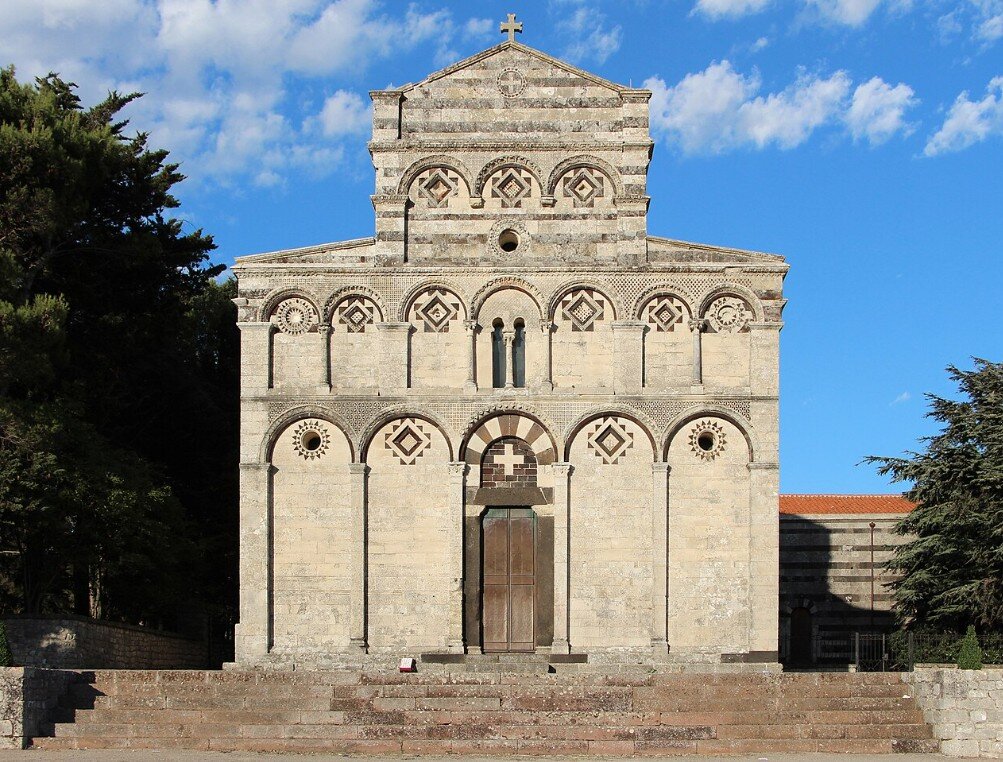
Perched on a volcanic hill in the territory of Borutta, the former cathedral of San Pietro di Sorres dominates the surrounding landscape. Declared a national monument in 1894, this church is an absolute masterpiece of Romanesque architecture in bichromy (alternating light and dark stones), but its true uniqueness lies in who inhabits it.
Unlike other historical sites, San Pietro di Sorres is a living structure: it actually houses the only active monastery of Benedictine monks in Sardinia today. The monks manage a fascinating antique book restoration laboratory and a very rich library. The unmissable experience? By booking in advance, it is possible to experience a moment of profound spirituality and sharing by having lunch together with the monks in their guesthouse (which can accommodate up to a maximum of 80 guests).
2. Sant'Antioco di Bisarcio: The Secret of the Pilgrims
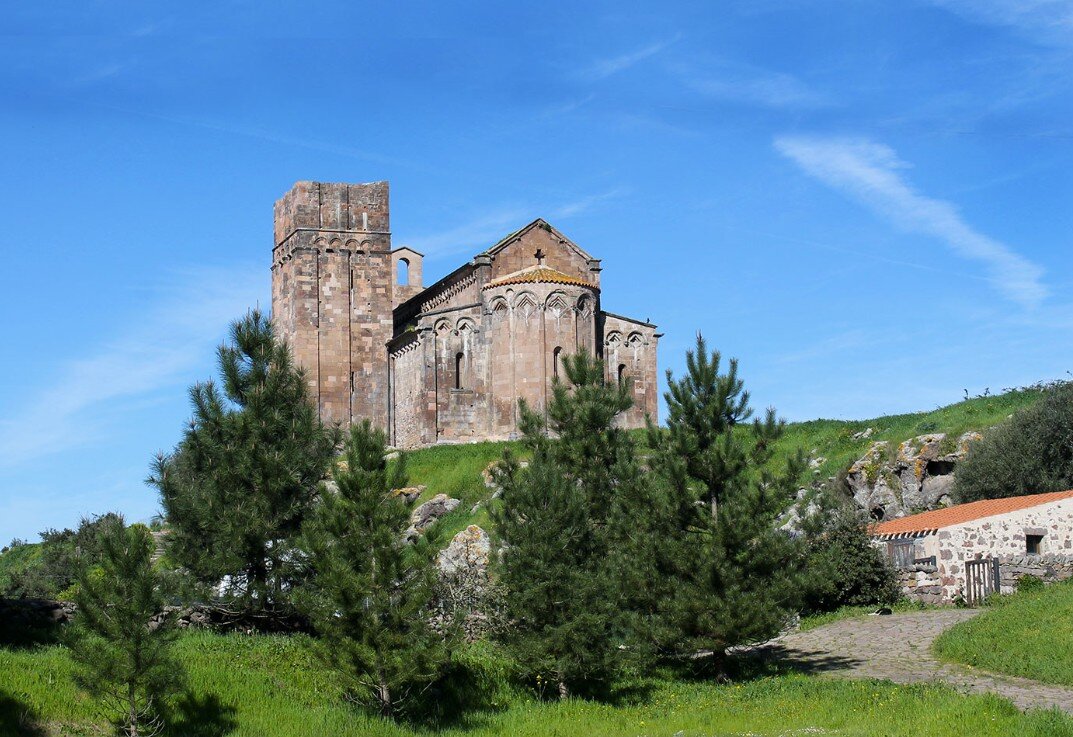
Moving towards Ozieri, you reach another volcanic plateau dominating the Chilivani plain. Here stands the Basilica of Sant'Antioco di Bisarcio, one of the largest and most evocative Romanesque churches on the island, the ancient seat of the diocese from 1065 to 1503.
Destroyed by a fire and rebuilt in 1164 by Pisan craftsmen, the church has two characteristics that make it a unicum in Sardinia:
- The two-story portico: Leaning against the facade (which appears asymmetrical due to a collapse in the 15th century), it housed the bishop's private rooms, including the chapter house, a chapel, and an ancient fireplace.
- The pilgrims' footprints: Looking closely at the internal stones, you can see ancient engravings in the shape of a "sandal". They were the signatures left by medieval travelers to testify their passage in this important place of worship. Today, around the basilica, you can still breathe the atmosphere of the past walking among the ruins of the medieval village and the ancient bishop's palace.
3. The Elephant Rock: A Prehistoric Giant
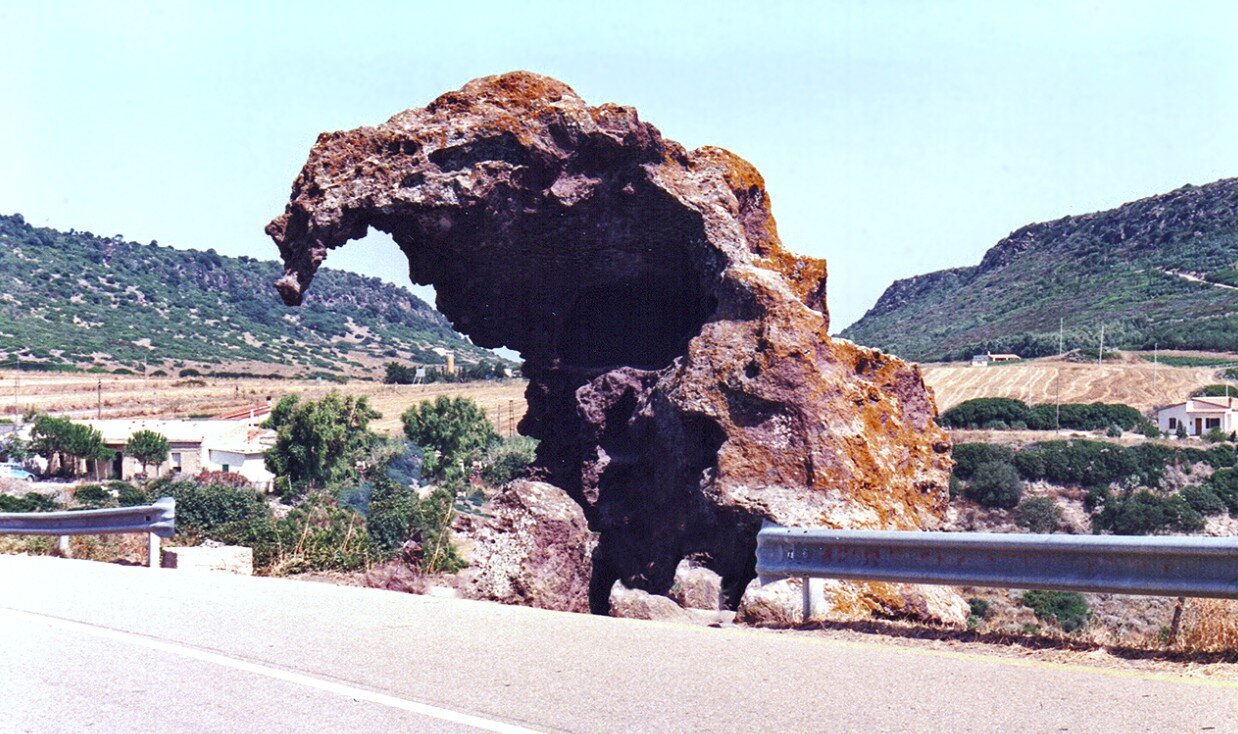
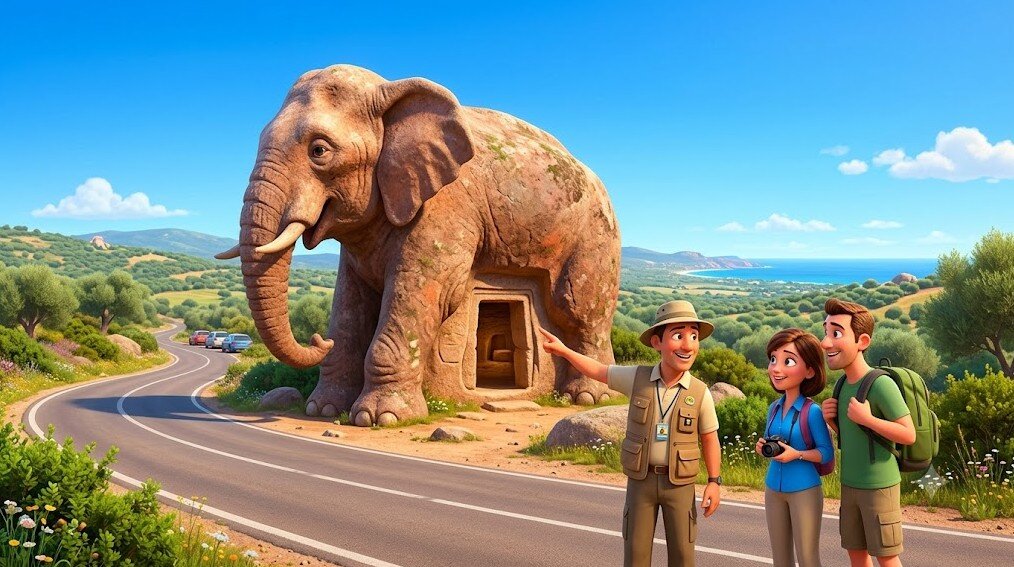
Leaving the Romanesque behind and driving towards Castelsardo, in the Anglona region, nature takes over with bizarre shapes. Along State Road 134, you come across a gigantic trachyte and andesite boulder four meters high, which broke off millennia ago from Mount Castellazzu. Atmospheric erosion has sculpted it, giving it the perfect shape of a seated pachyderm. Until 1914, before the scholar Edoardo Benetti renamed it the Elephant Rock (Roccia dell'Elefante), locals called it Sa pedra pertunta (the pierced stone).
But beware: this is not just a photogenic geological caprice! The boulder has enormous archaeological relevance. Inside, two Domus de Janas dating back to the Final Neolithic (3200-2800 BC) have been excavated. While the upper tomb is highly damaged, the lower one is perfectly preserved: entering the corridor (dromos) you can admire magnificent bovine protomes carved in relief on the walls, with characteristic crescent horns, ancient symbols of protective deities.
Your Base Camp at Villa Malvasio
Visiting such distant and isolated sites requires careful planning and, above all, a central starting point.
Villa Malvasio, strategically located on the outskirts of Sassari, is the ideal "Base Camp" to explore the hinterland of Northern Sardinia. After a morning spent between the mystical charm of Borutta and the volcanic hills of Ozieri, you can quickly return to base to escape the heat. Park your car in our private courtyard and regenerate by the pool, enjoying our exclusive Hushpitality guaranteed by only 8 beds in total.
🕒 Practical Info and Visits
- San Pietro di Sorres (Borutta): The abbey is open for religious and tourist visits. To organize lunches with the Benedictine monks or visits to the restoration laboratory, prior arrangements are essential. More info and reservations on the official website: www.sorres.it (Featured photo: Wikipedia).
- Basilica of Sant'Antioco di Bisarcio (Ozieri): It is reached from the old SS597 following the signs for Chilivani/Martis. Open from Tuesday to Sunday (10:00 - 13:00 and 14:00 - 18:00), closed on Mondays. The ticket of about €3 includes a guided tour. More info on the Municipality of Ozieri website (Photo by Giovanni Frau).
- Elephant Rock (Castelsardo): Located in Multeddu along the S.S. 134. The natural and archaeological monument is open-air and access is free, you just need to carefully pull your vehicle over on the side of the road (Photo by Claudio Kalb).