
A Black and White Mirage in the Plain
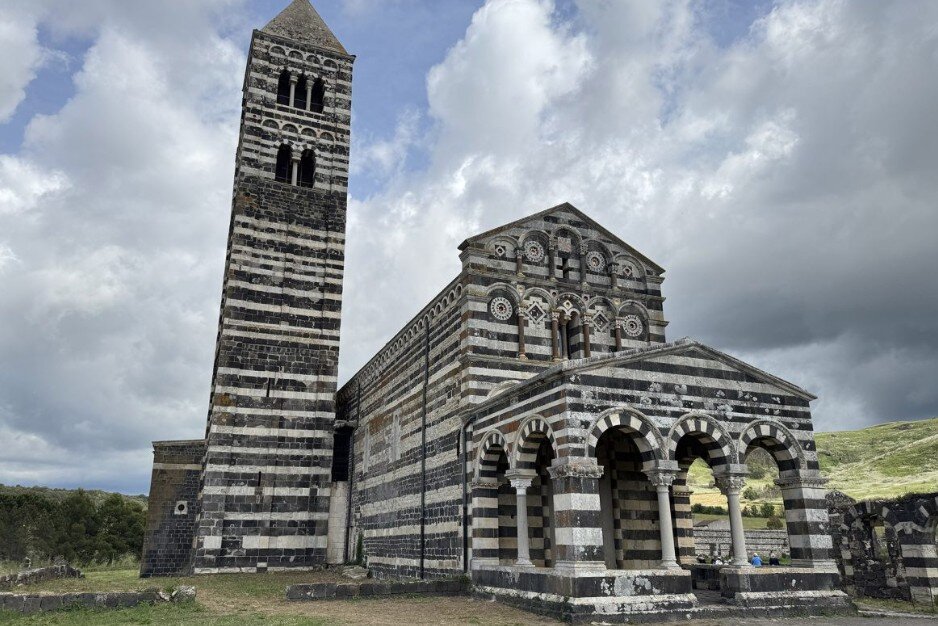
Driving along the SS131 highway in northwestern Sardinia, at a certain point the landscape opens up into a green valley in the territory of Codrongianos. Suddenly, a very tall dark bell tower rises solemnly, announcing one of the most spectacular visions of the island: the Basilica of the Holy Trinity of Saccargia.
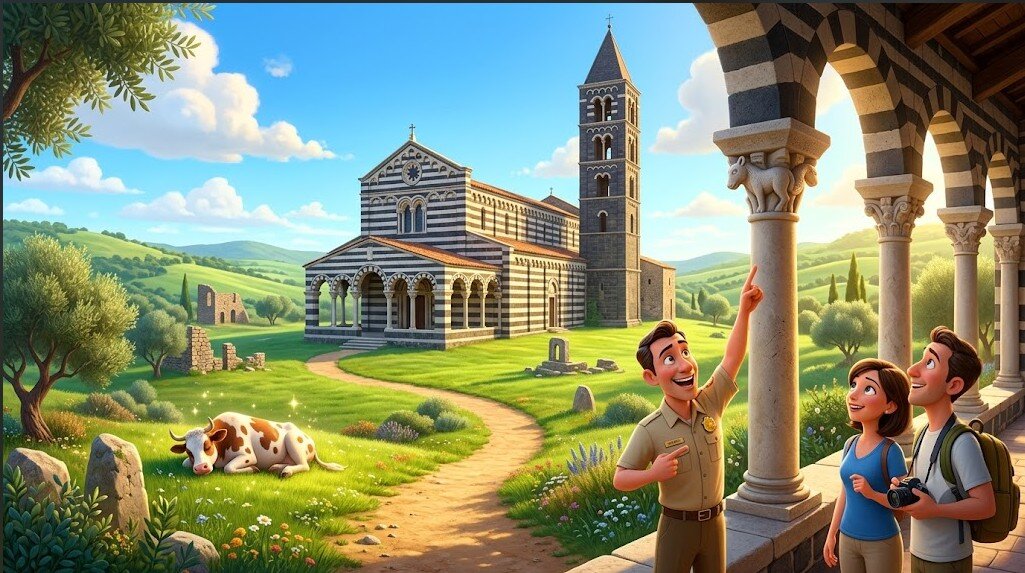
Unanimously considered the most famous and photographed medieval church in Sardinia, this majestic abbey from 1116 will leave you breathless with its geometric perfection. Imagine an imposing "T-shaped" structure built by alternating rows of white limestone blocks with black volcanic basalt blocks. An incredible bichrome optical effect, typical of Pisan-Romanesque architecture, that stands out like a mirage in the middle of the Sardinian countryside.
Between History and Legend: The Mystery of the "Spotted Cow"
The foundation of the complex, formerly inhabited by Camaldolese monks, is owed to Constantine I (King of the Judicate of Torres) and his wife Marcusa. The two sovereigns, desiring an heir, had the church built following a sacred apparition.
But the charm of Saccargia also lies in its name, which is rooted in an ancient and evocative myth. Popular legend has it that the name derives from s’acca argia, meaning "the spotted cow". It is said, in fact, that every day a cow with a piebald coat would arrive from the pasture to kneel in front of the monastery in an act of prayer, offering her milk to the friars. Confirming this ancient tale, if you look closely at the capitals of the entrance portico, you can spot crouching bovines carved into the stone.
Art and Monsters: The Hidden Treasures of the Basilica
The facade of the church, preceded by a magnificent portico added in the 13th century by Lucchese masters, is an embroidery of geometric inlays, small arches, and mysterious polychrome ceramic basins. Stepping under the arcade, fascinating and unsettling figures will welcome you: the capitals are in fact decorated with sculptures of fantastic animals and winged monsters resting on acanthus leaves, almost as if standing guard at the sacred entrance.
Once you cross the threshold, prepare for a very rare surprise for Sardinian architecture: the only cycle of Romanesque frescoes (12th century) preserved in its entirety in Sardinia. In the basin of the central apse, the vivid colors painted by Umbrian-Lazio artists break the nakedness of the stone, depicting an imposing Christ the Judge, surrounded by angels, apostles, and scenes from the life of Jesus. A true medieval illustrated book that has survived to this day.
Your Base Camp at Villa Malvasio
Visiting the Basilica of Saccargia is an unmissable journey for those who love art history and medieval architecture. It is only a few kilometers from Sassari and is a perfect hub for your archaeological itineraries.
By choosing Villa Malvasio as your Base Camp, you ensure a stress-free exploration of Northern Sardinia:
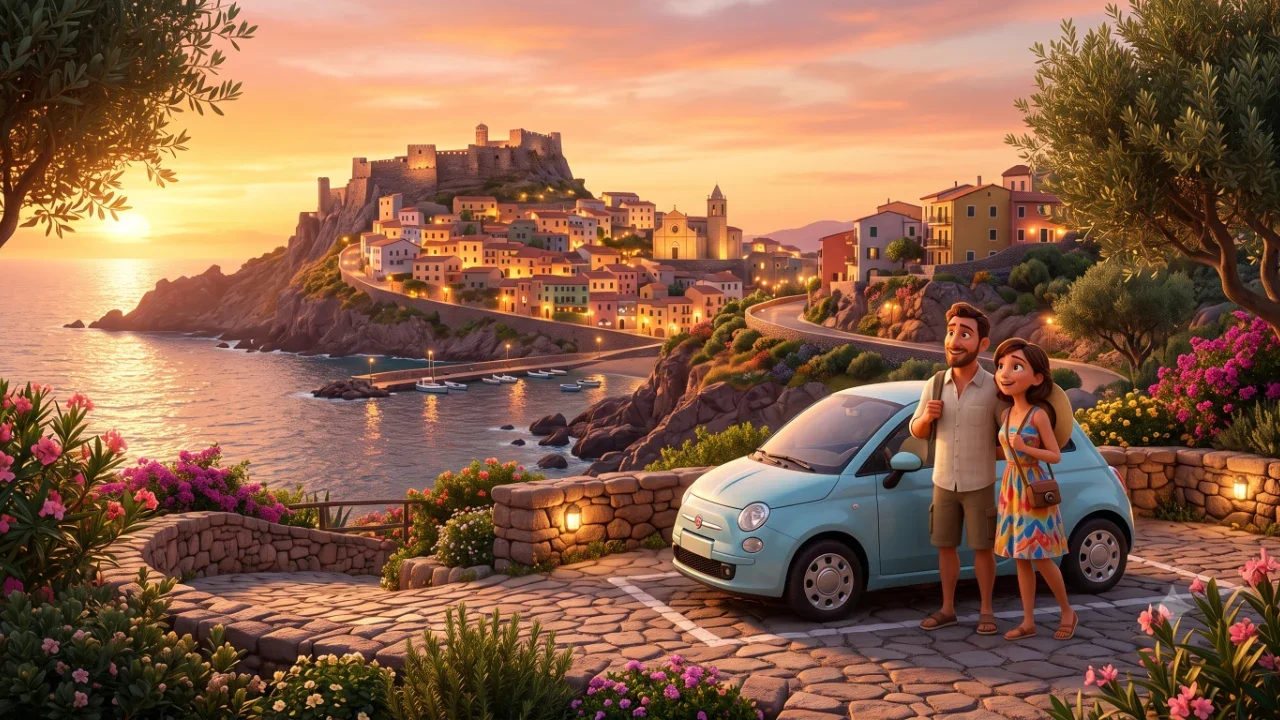
- Strategic Proximity: The Basilica is just over a 15-minute drive from our property, allowing you to visit it at a leisurely pace, perhaps early in the morning or at sunset to enjoy the best light on the bichrome stones.
- Informal Luxury: Returning to an intimate and exclusive environment (only 8 guests) is the best way to assimilate the beauty seen during the day.
- Absolute Relaxation: Leave your car in the internal parking lot, recharge it if necessary, and enjoy an aperitif by the pool in the silence of our estate.
🕒 Practical Info and Visits
The complex of the Basilica of Saccargia (with the adjoining ruins of the ancient monastery) is open to the public and is easily reachable by taking the exit on State Road 131, following the signs for Codrongianos / Olbia.
Being a site of immense tourist and historical value, we strongly suggest you take advantage of the guided tour service often available on-site, so as not to miss the hidden sculptural details (such as the embedded face of Judge Constantine) and to learn about the techniques of the ancient frescoes.
Note for explorers: An even more evocative visit can be made on the Sunday following Pentecost, when the site comes alive with religious rites, folk shows, and traditional poetry competitions in the Sardinian language.